|
The Record
Keeper
CARDINAL SINS: RUFFING PARTNER'S WINNER
By Nikos Sarantakos, Luxembourg
In this article we'll examine what is perhaps
considered the worst crime in bridge: ruffing partner's winner. 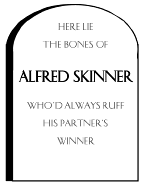
In fact, in a recent issue of Bridge Plus,
there was a cartoon with the tombstone of a certain Mr Skinner (composed
by J. Barnes of Newcastle) who was in the habit of ruffing his partner's
winners - and presumably met with violent death at the hands of some irate
partner. Without going to such extremes, suffice it to say that ruffing
partner's winner is usually not going to gain partner's applause.This
being the case, it is not perhaps strange that many players are reluctant
to ruff their partner's winner even when this manifestly is the winning
move. A shrewd declarer can benefit from this inhibition, as in the
following deal, reported originally by Barry Rigal from a US National
Championship:
Dealer: South. N/S Vul.
|
|
 K 6 3 K 6 3
 K J 10
3 K J 10
3
 A
8 A
8
 K
5 4 3 K
5 4 3 |
|
9
Q
Q 9 6 5 2
A Q 8 7 6
2 |
 |
A 10 8 7 4
7 6
2
J
10 7 4
10 |
|
Q J 5 2
A 9 8 5
4
K
3
J
9 |
|
South opened 1, West overcalled with 2NT
(the Unusual No-trump for the minors) and North closed proceedings with
4.
The 9, a likely singleton, was led to the ace. Back came 10, another likely
singleton, covered by the jack and won by West's ace. Now West plays a
rather eloquent Q. East ruffs the king and fires back a spade to return the
favour and beat the contract, right? Yes, but what if declarer refuses to
put dummy's king on West's Q? It should make no
difference, but this particular East had a strong aversion to ruffing his
side's winners - so West's queen won the trick and the subsequent spade
ruff disappeared. Contract made!
In the rest of this article we'll see some examples where
defenders did not shrink in horror when it came to ruffing their partner's
winner.
Our first exhibit comes from the Open Pairs event of the
1996 China Cup:
Dealer: East, E/W Vul.
|
|
8 7 4
7 6
9 8
K J 10 8 6
4 |
|
J 3
Q J 10
5
A
J 5
Q 7 5 2 |
|
K Q 9 5 2
K 9 4
2
K
4 2
9 |
|
A 10 6
A 8
3
Q
10 7 6 3
A 3 |
|
| West |
North |
East |
South |
| Weinstein |
Helness |
Stewart |
Helgemo |
| |
|
1 |
Dbl |
| Pass |
2 |
Pass |
Pass |
| Dbl |
Pass |
Pass |
2 |
| Dbl |
End |
|
|
Fred Stewart of the USA opened 1 and Geir Helgemo of Norway
doubled with the South cards (not exactly a text-book double!). You may
have doubts about the strong-pass-then-double method employed by West and
in fact, since East-West can make ten tricks in hearts, Helgemo's doubled
contract stood to gain, especially if he could manage to get away with
only one down.
Steve Weinstein (USA) led J. Declarer won with his ace
and ducked a heart. Weinstein played low since he wanted partner to win
the trick and play a trump through South. This duly happened and Weinstein
won his jack, cashed the ace of trumps, and switched to his low spade.
East won and continued with a third spade.
Now, West knew that driving out A was urgent. Afraid that
his partner might well elect to continue with a fourth spade, Steve
Weinstein ruffed his partner's winner and played a heart himself, going
out of his way to make things easy for Stewart. Declarer won, and played
A and club to
the jack but East ruffed this with his king, and was able to cash a heart
for two down.
In this last example, the sin was committed as a safety
measure; in our next exhibit, it was essential in order to beat the
contract:
Dealer: West. Game All.
|
|
J 9
Q 10 8
K 9 7 5
3
A
4 2 |
|
3 2
J 7 5 4 3
A 10 6
2
7
6 |
|
K 8 7 6
9
Q J
4
K
Q J 8 5 |
|
A Q 10 5 4
A K 6
2
8
10 9 3 |
|
| West |
North |
East |
South |
| Nilsland |
Koch- Fallenius |
Auken |
Palmund |
| Pass |
Pass |
1* |
1 |
| Pass |
1NT |
Pass |
2 |
| Pass |
2 |
End |
|
| * Precision, not necessarily
long diamonds |
The deal comes from the Scandinavian Derby between Sweden
and Denmark for the 1995 European Championships in Vilamoura, Portugal.
The Swedish West, Mats Nilsland, led 7 to East's jack. Declarer,
Denmark's Jens Auken, ducked, won the K continuation with the ace,
and then played A and a heart to the queen - an unnecessary move that he was to
regret bitterly when East ruffed and then played Q.
Nilsland rose to the occasion: he ruffed his partner's
winner and fired back J (suit-preference for diamonds) for East to ruff. Bjorn
Fallenius duly ruffed, played a diamond to West's ace and received yet
another ruff for one down.
Astute readers will have noticed that declarer can actually
make ten tricks in spades as the cards lie if he simply goes about his
business of drawing trumps instead of dabbling with hearts. Still, he
received the deserved punishment only because Nilsland didn't hesitate to
ruff his partner's winner.
In our next example some didn't dare commit the sin, some
went for it and others even pulled their partners away from it!
Dealer: East. N/S Vul.
|
|
J 8 4
Q J
A K 9 8 3
2
Q
J |
|
-
A K 9 8 7 4 3
2
Q
7
9
8 4 |
|
A K 10 9 7 3
5
J 10 6 5
4
3 |
|
Q 6 5 2
10
6
-
A
K 10 7 6 5 2 |
|
This wild deal comes from the last edition of the late and
much lamented Macallan (formerly Sunday Times) tournament.
Although East-West cannot make 4 (unless playing against
close relatives), understandably most Souths competed to 5 and were doubled there.
Would that cost 500 or 800?
At one table, Xu Hongjun began proceedings against 5 by leading A and K. Zhuang Zejun,
his partner sitting East, ruffed the king without a flicker and started on
spades: this allowed the Chinese pair to collect five tricks for 800.
At another table, Omar Sharif was West: he also led A but when his
partner, Christian Mari of France, followed with 5 (an obvious singleton by
their methods), Omar switched to 9, forcing partner to ruff
and switch to spades.
Just in case you scoff at going to such lengths to make
things clearer for one's (expert) partner, witness what happened at
another table, where against the same contract Tony Forrester led A and K. His partner
didn't find it necessary to ruff, so the penalty was a mere 500 points.
(Said partner shall remain nameless, but he was not Andrew
Robson!)
Speaking about Omar Sharif, although we saw him in the act
of pulling partner away from the path of sin, he is known to have
committed the sin himself:
Dealer: South. Love All.
|
|
5 2
K Q 8 6
A K Q
9
K
J 7 |
|
Q
9 5
10 8 4 2
A Q 10 9 6
5 |
|
A K J 10 7 4
3
4
3
J
6 3
8 |
|
9 8 6
A J 10 7
2
7
5
4
3 2 |
|
| West |
North |
East |
South |
| Sharif |
Mouiel |
Jourdain |
Kowalski |
| |
|
|
Pass |
| Pass |
1 |
3 |
Pass |
| Pass |
Dbl |
Pass |
4 |
| End |
|
|
|
The deal comes from the 1998 Generali Masters, an
invitational Individual tournament. Against 4 by South, Sharif led his
singleton Q.
Patrick Jourdain overtook and fired back his singleton club. Omar won and
gave him his ruff. Then East continued with 10 and Sharif ruffed his
partner's winner to give him another club ruff. This good defence achieved
two down, but it turned out as a below average score for Sharif. Why?
Because at no fewer than seven tables West opened with 3 (yes, in second
position: it was an individual, after all), North over-called with 3NT
ending the auction, and then East proceeded to cash seven spades and a
club, for a 200 points penalty! So, in Sharif's case, sin was its own
reward, so to speak.
These few examples show that there always is a silver lining
even in the darkest cloud; so next time your partner ruffs your winner,
don't rush to yell at him: it might be a brilliant move after all. Yet if
he is doing it consistently, or if he ruffs your ace with the ace of
trumps, it might help if you show him Mr Skinner's tombstone!
|